Yap
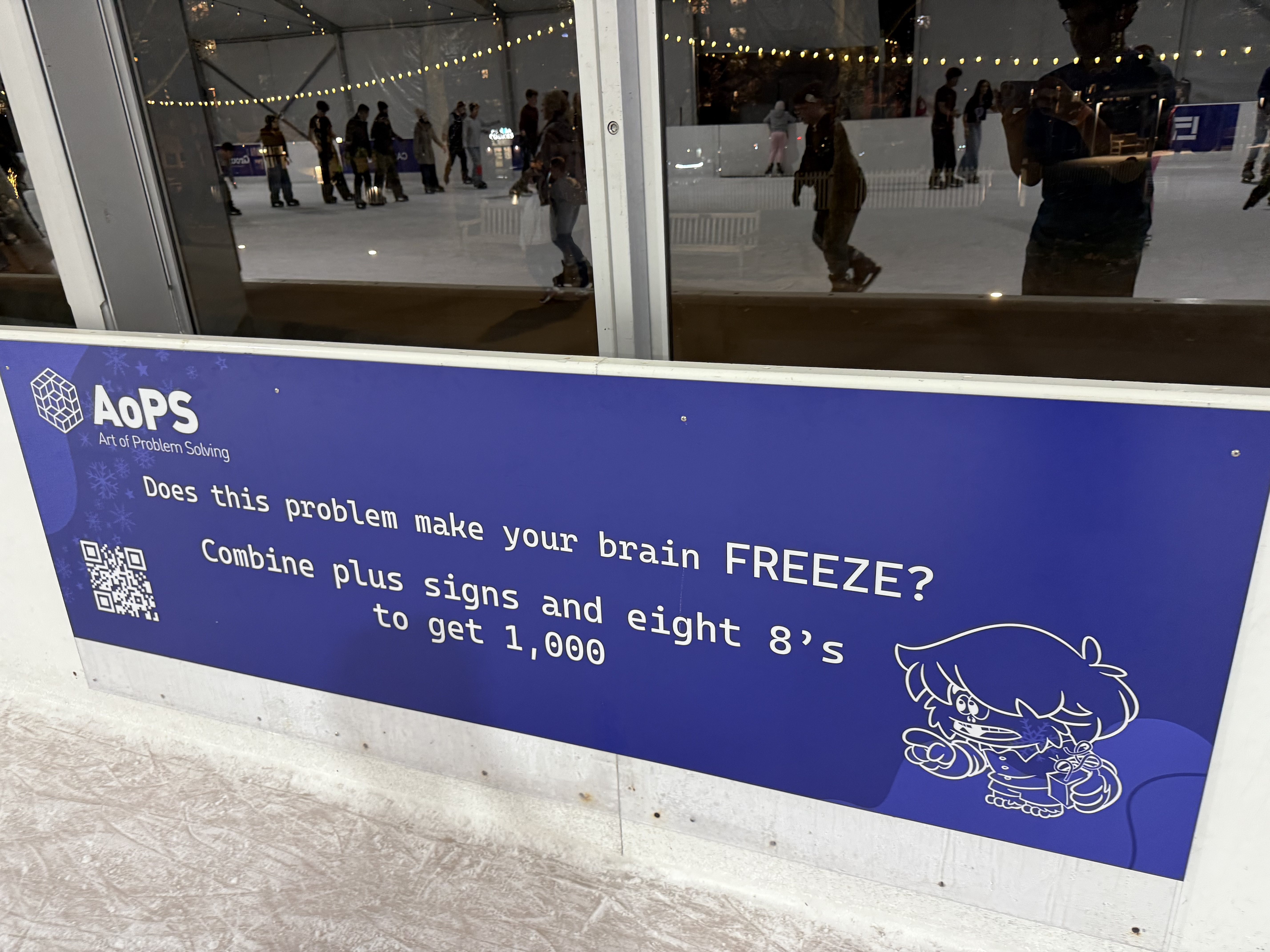 I went ice skating today. I only go around once a year, which means I basically forget any progress I make in not looking like a monkey when I try each time. Just as I started to remotely get the hang of it for the third time in my life, I went to take a look at all the sponsors of the rink putting ads around it. One that caught my eye was, of course, from AoPS, which is what is shown on the image:
“Does this problem make your brain FREEZE? Combine plus signs and eight 8’s to get 1,000.”
While the problem was really simple just by brute forcing and intuition that even a six or seven year old (hehe) could solve it. The ad was, after all, placed to a general audience, not a bunch of orz IMO quals.
However, out of my annoyingness, I sought to prove rigorously that the answer I got was the only possible one. I did this in my head, closing any logic holes, while at the same time figuring out how to ice skate properly (at least I was getting better at moving continuously, but my center of mass was still all over the place, so I ended up looking like a monkey anyway, but at least I never fell in the entirety of the hour I was there). So, without further ado, here’s the solution:
Actual Solution
Assume there are \(n\) numbers being added up. \(1 \leq n \leq 8\), since there are at most eight numbers, which means there is one per digit, and at least one number, which is when all the digits are in one number.
Now, we consider the sum mod \(10\). Since all \(n\) numbers have a units digit of \(8\) as it’s the only possible digit, and they add up to \(1000\), we get \(8n \equiv 0 \pmod{10}\). What this means is that \(8n\) is a multiple of \(10\), so it must also be a multiple of \(5\), since \(10\) is a multiple of \(5\). Since \(8\) is not a multiple of \(5\), but \(8n\) is a multiple of \(5\), then \(n\) must be a multiple of \(5\). The only multiple of \(5\) between \(1\) and \(8\) is \(n = 5\). Therefore, we have five numbers being added up.
We know that the maximum possible number is \(888\), because \(8888\) is already greater than \(1000\). If there are \(2\) or more \(888\)’s being added up, then the sum is also over \(1000\).
We wish to prove that there are not zero \(888\)’s either. Assume by contradiction that there actually are zero \(888\)’s, so the maximum possible number is just \(88\). Now, the maximum possible sum is just \(4 \cdot 88\) which is far less than \(1000\) (this is the maximum because every \(88\) is the equivalent of adding eleven \(8\)’s). Also, to verify that in my head, instead of calculating, I just saw that \(4 \cdot 88 < 4 \cdot 100 = 400 < 1000\). Therefore, there must be exactly one \(888\) being added up.
We find the remaining four numbers must add up to \(112\). We can do a similar process to find the number of \(88\)’s that must be present. If there are no \(88\)’s, then the maximum sum is \(32\), not even close to \(112\). However, if there are two or more \(88\)’s, then the sum is already over \(112\). Therefore, there must be exactly one \(88\) present.
Since there is exactly one \(888\) and exactly one \(88\), and there aren’t any higher possible numbers, the remaining three \(8\)’s are used with one \(8\) per number, filling up the remaining three numbers needed.
Therefore, the final sum is \(\fbox{888 + 88 + 8 + 8 + 8 = 1000}\). There are also \(40\) different ways to rearrange that same equation and keep it true, because it’s \(2 \cdot \frac{5!}{3!}\) (the \(5!\) is to rearrange all the five numbers being added, the \(3!\) is because we don’t care the order the individual \(8\)’s are in because it’s all the same, and the \(2\) is to make the sum on the left hand side or the right hand side).